
1. What are you trying to solve?
Meowdoku is a visual placement puzzle. You are finding the occupied squares, not filling every square with a number. The colored areas are regions: their shapes matter more than whether their colors look similar. On a square board with the same number of regions as rows, a completed puzzle has one cat in each row, column and region.
Treat a board as three overlapping lists of possible positions. Every square belongs to a row, a column and a region. A legal cat must work in all three lists at once. It must also stay away from neighboring cats, including diagonal neighbors.
2. Exactly one cat per colored region
A tiny region is a good place to start because it contains fewer possible squares. If the region is a single cell, that cell must hold its cat. If it has several cells, do not pick the prettiest location: first use other constraints to reduce the choices.
Once a region has its cat, every other cell in that region becomes an X. A long winding region can span several rows; the rule still allows only one cat in the entire connected shape.
3. Exactly one cat per row
Read each horizontal line from left to right. When you place a cat, mark the rest of that row. Conversely, if only one possible square remains in a row, that square is forced. A row with several open squares is not ready yet; keep the candidates visible and inspect the intersecting regions.
4. Exactly one cat per column
Columns obey the same rule vertically. After a placement, sweep the column from top to bottom. It is easy to notice the row and forget the column; that omission leaves misleading open candidates elsewhere on the board.
5. Cats cannot touch, including diagonally
Two cats cannot occupy cells that meet at a side or a corner. Side-by-side cats already break the row rule; vertically touching cats already break the column rule. Diagonal contact is the extra restriction to check carefully. It only concerns neighboring cells, not the whole diagonal of the board.
This is not the classical chess-queen rule. Two cats several cells apart on a diagonal may be legal. After every placement, inspect its immediate surroundings before moving on.
6. Understand the app’s controls
The Oakever App Store description specifies a double-tap to place a cat and a three-heart mistake system. Use the first tap to annotate the board rather than committing to a guess. Controls, events and assistance can differ between app versions, so check the in-app tutorial if your interface behaves differently.
Whiskerdoku’s browser practice uses explicit Cat, X and Erase tools, plus keyboard shortcuts. It is an independent practice game. The rules transfer; button layouts and level numbering do not have to match the mobile app.
In the Meowdoku app
Follow the app’s tap tutorial. Double-tap a proven position to commit a cat; keep an eye on hearts.
In browser practice
Select Cat or X, then tap a square. Undo and an explanation-based hint are available next to the board.
7. Use X marks as written reasoning
An X means “this square cannot contain a cat,” not “this square is empty in the answer I happen to remember.” Put an X only where a rule or a deduction rules the square out. The marks make your reasoning visible and stop you from reconsidering the same impossible positions.
If you get stuck after an early guess, remove the guess and its consequences. A wrong cat can be easy to spot; a wrong X can silently hide a forced move. This is why a useful hint sometimes asks you to undo a mark instead of showing a new cat.
8. Use hints, undo and reset deliberately
Undo is best for reversing the most recent uncertain action. Reset is useful when a chain of guesses has made the board hard to audit. A hint should be a learning aid: inspect the affected region, ask why the position is possible, and apply the same idea elsewhere.
Before requesting help, run one complete row–column–region check. If you are spending hearts in the app, stop committing cats until you can explain the next move. Marking candidates is safer than trying several unsupported locations.
9. The solving loop that works
- Inspect small regions. Find single cells or shapes with very few legal choices.
- Place a forced cat. Use a row, column or region that has only one candidate.
- Clean up all consequences. Mark its row, column, region and immediate neighbors.
- Rescan. The cleanup often creates another single candidate.
- Look for locks. If a region’s candidates lie in one row or column, reserve that line for the region.
Do not keep staring at the cell you want to solve. Switch to a region that has just lost candidates. Solving often becomes a chain of small, certain observations.
10. Follow a complete worked board
Open the documented Meowdoku Level 1 walkthrough. Compare its initial frame with your board, then read the placement explanations before revealing the answer. The guide shows the original video context, a clean redraw and the final coordinates.
For every step, ask three questions: which candidates disappeared, which rule removed them, and which unit now has one option? This method teaches you to solve the next board, rather than just copy the current answer.
On this recorded Level 1 board, R3 C4 is already filled. R1 C3 and R2 C1 are each a one-cell region, so they are forced. After those three cats, columns 1, 3 and 4 are occupied. The final cat must be R4 C2. Read the diagram below as a sequence of exclusions, not four unrelated coordinates.
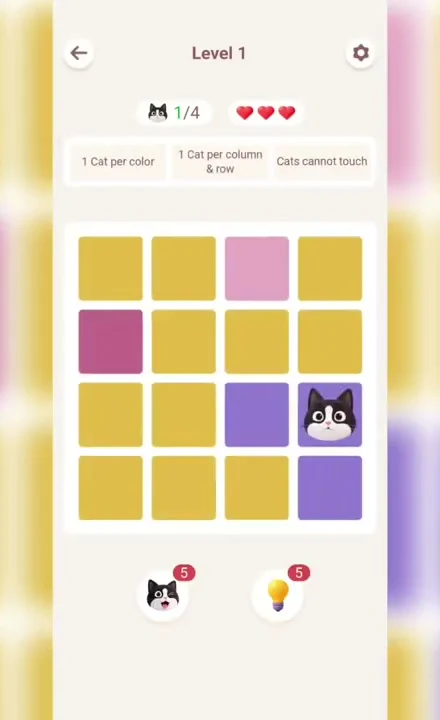
Video loads only when you press play. Open on YouTube ↗
11. Common beginner mistakes
- Counting a color twice. Follow the region boundary, not just a nearby patch of color.
- Forgetting a diagonal neighbor. Check the 3×3 neighborhood around a new cat.
- Blocking the whole diagonal. Only immediate contact is forbidden.
- Guessing before marking. A plausible cell is not necessarily a proven cell.
- Copying a different board. Match the region shapes in the guide with your version first.
12. Meowdoku questions, answered
Is Meowdoku a real Sudoku game?
It shares placement logic, but uses cats and shaped regions instead of digits 1–9. You do not need arithmetic to solve it.
Is Meowdoku free?
The official store listings offer a free app with ads and in-app purchases. Whiskerdoku browser practice is also free; it does not require an account.
What does Meowdoku unblocked mean?
Usually it means playable in a browser on a network where game sites may be restricted. We cannot change a school or workplace network’s access rules. Use the browser game where your network allows it.
Why is my level different from the video?
App updates, tutorial boards, events and different publishers can use different layouts. Match the complete region pattern rather than relying on the number alone.